
How to Choose the Right RCCB for Your Home
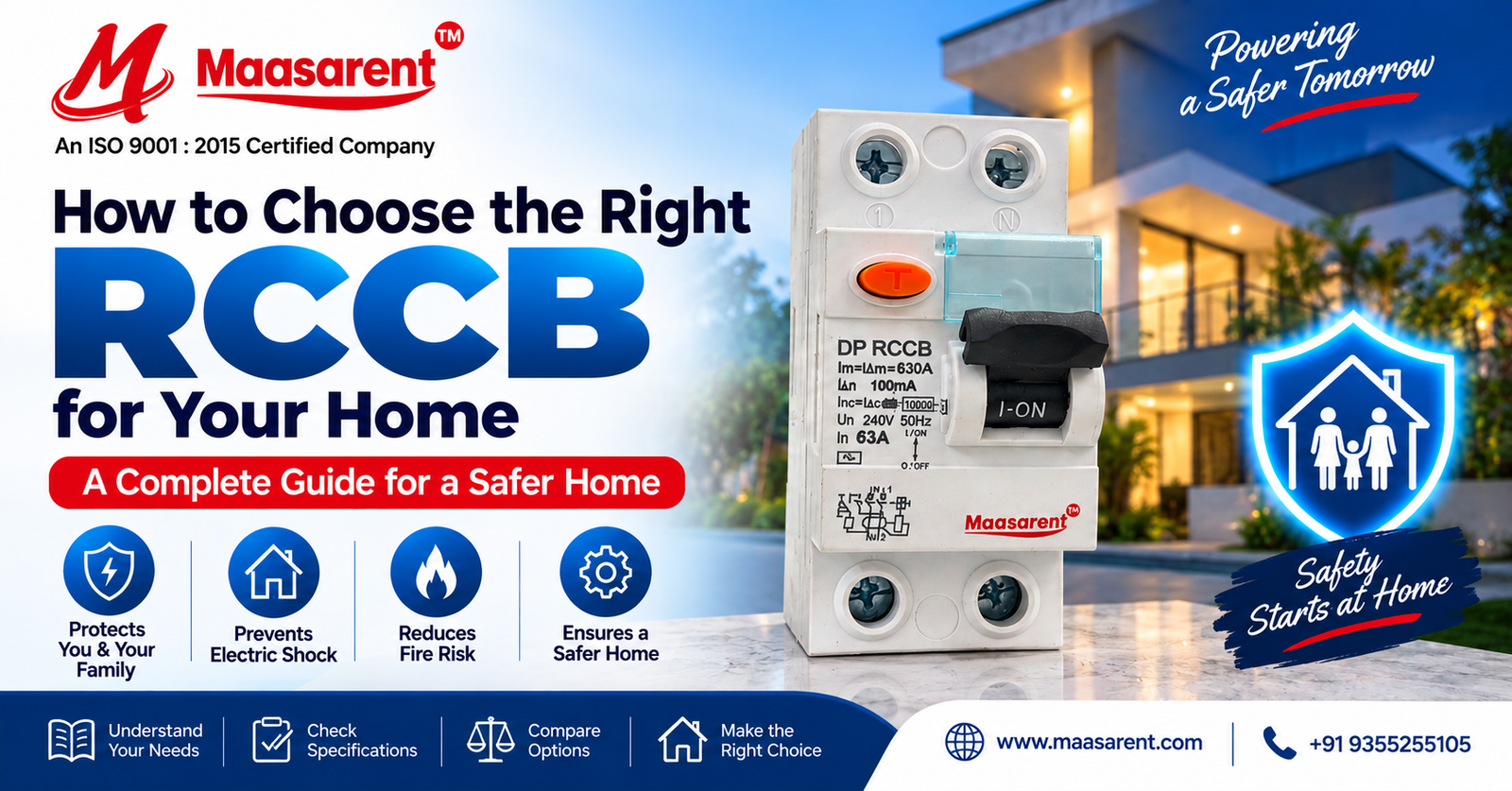
How to Choose the Right RCCB for Your Home | Maasarent
How to choose the right RCCB for your home
https://maasarent.com/blog/how-to-choose-the-right-rccb-for-your-home
RCCB, Electrical Safety, Home Electrical, Circuit Protection, Electrical Products
Electrical safety starts with choosing the right protective devices for your home. One of the most important devices in a modern electrical distribution board is an RCCB (Residual Current Circuit Breaker). An RCCB helps detect residual or leakage current and disconnects the circuit when the leakage reaches its operating threshold.
But choosing an RCCB is not simply a matter of picking the highest ampere rating. You need to consider the home's electrical load, the number of poles, residual-current sensitivity, device type, installation arrangement and compatibility with the rest of the protection system.
For many residential applications, a 30 mA residual-current protection device is commonly used where additional protection against electric shock is required. The correct current rating and device type must still be selected according to the installation design and local electrical requirements.
What Is an RCCB?
RCCB stands for Residual Current Circuit Breaker. It monitors the current flowing through the conductors of a circuit. Under normal conditions, the current leaving through the live conductor should return through the intended neutral path. If some current leaks to earth—for example through damaged insulation, faulty equipment or accidental contact—the RCCB can detect the imbalance and trip the circuit.
Unlike an MCB, an RCCB is primarily intended to respond to residual-current leakage. An MCB, on the other hand, provides protection against conditions such as overload and short circuit. In a properly designed installation, these devices perform complementary roles rather than replacing one another.
Why Does Your Home Need an RCCB?
Homes contain many appliances that can develop insulation faults or leakage currents over time. Moisture, damaged cables, ageing insulation, faulty appliances and incorrect wiring can all create electrical hazards.
Leakage Detection
Detects a difference between outgoing and returning current and can disconnect the circuit.
Shock Protection
A suitable high-sensitivity device can provide additional protection against electric shock.
Home Safety
Useful as part of a coordinated protection system for residential circuits.
1. Choose the Correct Current Rating
The RCCB's current rating is expressed in amperes, such as 25A, 40A, 63A or higher. This rating is the maximum continuous current the device is designed to carry under its specified conditions. It is not the same thing as the RCCB's residual-current trip sensitivity.
To choose the appropriate rating, consider the design current of the circuit, the upstream protective device, cable capacity and the overall distribution-board arrangement. For example, a 63A RCCB may be appropriate in some residential main-distribution applications, but the correct choice depends on the actual installation design.
| RCCB Rating | Typical Consideration | Important Note |
|---|---|---|
| 25A | Smaller circuits or installations | Must match circuit and upstream protection |
| 40A | Common residential distribution applications | Confirm load, cable and protective-device coordination |
| 63A | Higher-load residential distribution boards | Selection should follow the installation design |
2. Understand RCCB Sensitivity: 30 mA, 100 mA and 300 mA
RCCB sensitivity is measured in milliamperes (mA) and refers to the residual current at which the device is designed to operate under its specified conditions.
30 mA: Commonly selected for additional protection against electric shock in appropriate final-circuit applications.
100 mA: May be used for certain distribution or protection arrangements where the installation design calls for it.
300 mA: Often associated with higher-level protection strategies, including some fire-risk or upstream protection applications, subject to the applicable electrical design.
3. Select the Right Number of Poles
RCCBs are available in different pole configurations. For a typical single-phase home supply, a 2-pole RCCB is commonly used so that the live and neutral conductors are monitored and disconnected together where required by the device design and wiring arrangement.
For three-phase installations, 4-pole RCCBs are commonly used to provide protection across the three phases and neutral.
Commonly used for single-phase residential applications.
Commonly used in three-phase systems with neutral.
4. Type AC or Type A: Which One?
The RCCB type determines the kind of residual current waveform the device is designed to detect.
Type AC devices are intended for sinusoidal alternating residual currents. They can be suitable for certain conventional AC loads where the installation requirements permit their use.
Type A devices can detect AC residual current as well as certain pulsating DC residual currents. They are often considered where modern electronic equipment—such as appliances with electronic power supplies, variable-speed controls or other rectifying electronics—can influence the residual-current waveform.
The appropriate type should be selected according to the connected equipment and the applicable standards or installation requirements. When in doubt, consult a qualified electrical professional rather than selecting a device based only on price.
5. Check the RCCB's Compatibility With Your MCBs
An RCCB does not normally replace an MCB. An MCB protects against overload and short circuit, while an RCCB is designed primarily for residual-current protection.
For a safe distribution board, the devices should be coordinated so that the cables and protective devices are appropriately rated. The RCCB current rating should also be compatible with the installation and the upstream/downstream protective arrangement.
6. Look at the Rated Voltage and Frequency
Before buying an RCCB, check its rated operating voltage and frequency against your electrical supply. Many residential devices are designed for common low-voltage AC systems, but the exact rating must match the installation.
Never assume that two devices are interchangeable just because their ampere ratings are identical. Check the complete marking on the product and the manufacturer's technical specifications.
7. Check the Device's Standards and Quality
Electrical protection devices should be sourced from reputable manufacturers and should carry the appropriate markings and certification information required for the market in which they are sold.
Look for clear product identification, rated voltage, current rating, residual-current rating, device type, frequency, applicable standard information and manufacturer details. Avoid unverified products with unclear specifications.
8. Consider Where the RCCB Will Be Installed
The installation location matters. A home distribution board may supply lighting, sockets, kitchen equipment, air conditioners, water heaters and other appliances. Depending on the design, one RCCB can protect multiple circuits, or separate RCCBs/RCBOs can be used to improve circuit-level selectivity and reduce unnecessary loss of power when a fault occurs.
Areas exposed to moisture or equipment with a greater potential for leakage should receive particular attention. Local electrical rules and the recommendations of the equipment manufacturer should always be followed.
9. Test the RCCB Regularly
Many RCCBs include a TEST button. This allows the protective function to be checked according to the manufacturer's instructions. Testing should be carried out at the recommended interval and under safe conditions because pressing the button should cause the device to trip and disconnect the protected circuit.
If the RCCB does not trip when tested, or if it trips repeatedly during normal operation, do not ignore the issue. Have the electrical installation checked by a qualified professional.
Common Mistakes to Avoid
- Choosing an RCCB only by ampere rating.
- Confusing 30 mA sensitivity with a 30A current rating.
- Using an RCCB as a substitute for an MCB's overload and short-circuit protection.
- Ignoring whether Type AC or Type A is appropriate for connected loads.
- Installing the wrong number of poles for the supply arrangement.
- Buying products with unclear specifications or questionable authenticity.
- Attempting electrical-panel modifications without qualified professional assistance.
A Simple RCCB Selection Checklist
Why Maasarent?
When selecting electrical protection equipment, reliability, clear specifications and product quality matter. Maasarent offers electrical protection products designed for residential, commercial and industrial applications, including RCCBs and other protection devices.
Maasarent — Reliable Electrical Solutions
Explore electrical protection products for safer homes, offices and industries.
Visit MaasarentFinal Thoughts
Choosing the right RCCB for your home requires more than selecting a popular ampere rating. You should consider the electrical supply, current rating, residual-current sensitivity, pole configuration, RCCB type, connected loads and coordination with other protective devices.
A correctly selected RCCB can be an important part of a home's electrical safety system, but it is only one part of that system. Proper earthing, suitable wiring, correctly rated MCBs, good installation practices and regular inspection are equally important.
For any electrical installation or modification, use a qualified electrician and follow applicable local electrical codes and manufacturer instructions.